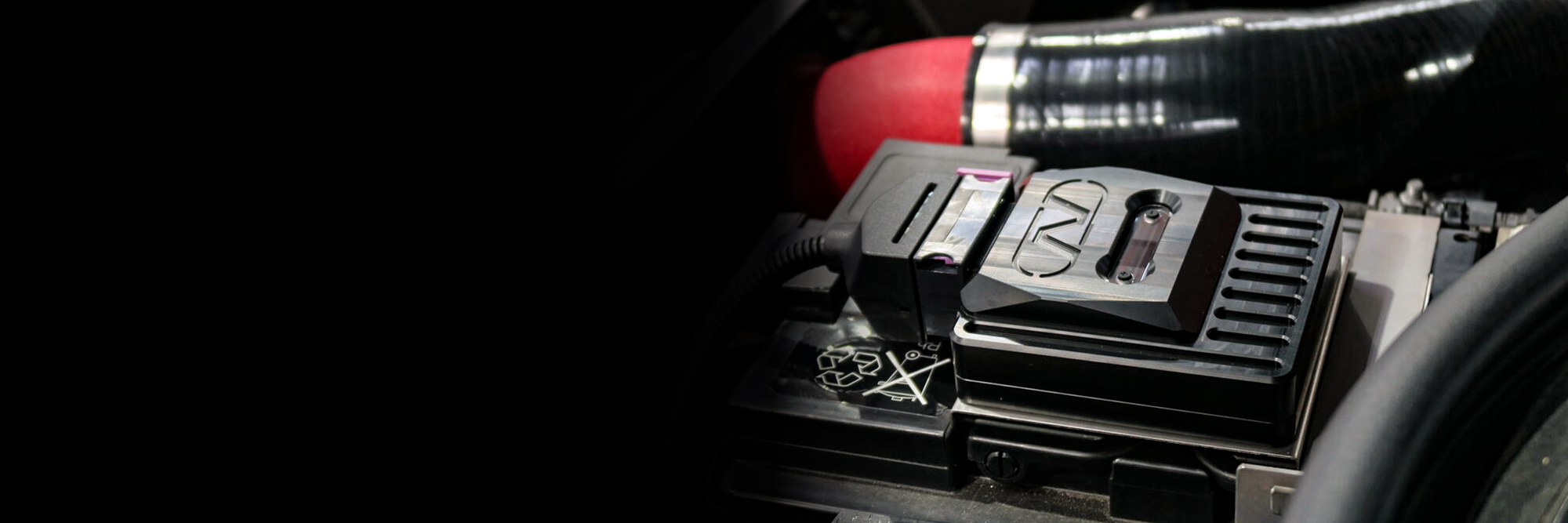
The following vehicles have the ECU located under the base of the windshield, next to the windshield wiper assembly. A black plastic or metal cover that runs the entire length of the windshield covers the ECU.
The following vehicles have the ECU located in a black plastic box located in the engine compartment on the driver's side, next the firewall and brake fluid reservoir. Five Phillips head or T30 Torx screws hold the box lid on. Some later models may require the removal of an additional factory RF shield.
The following vehicle has the ECU located underneath the top panels of the dashboard.
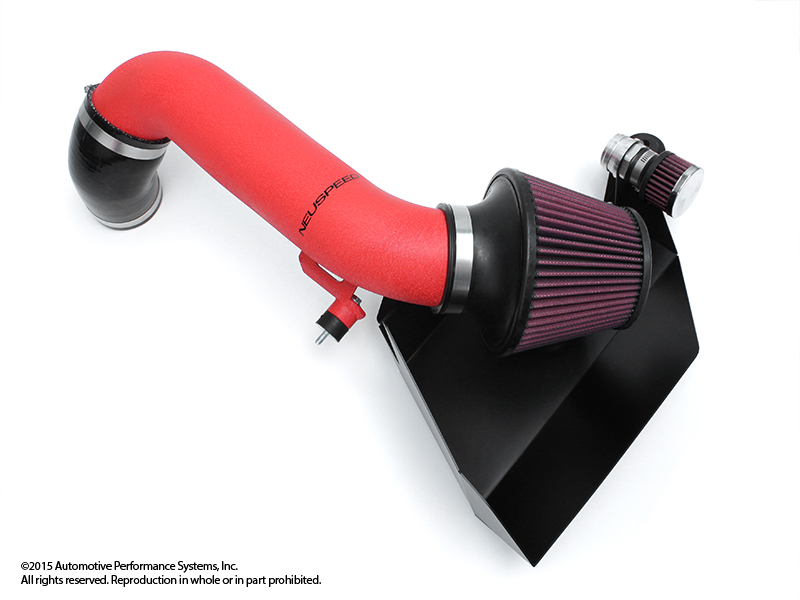
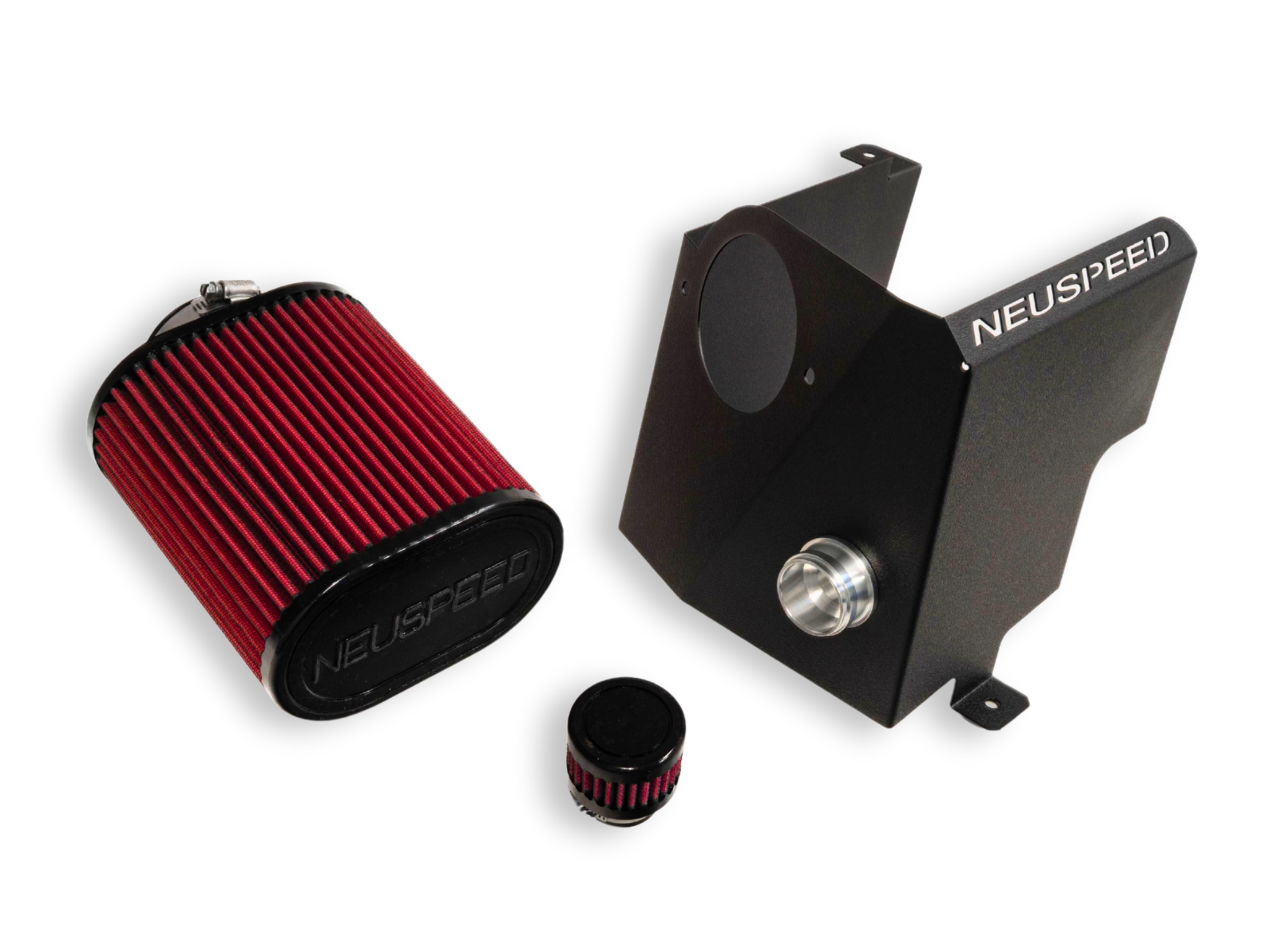
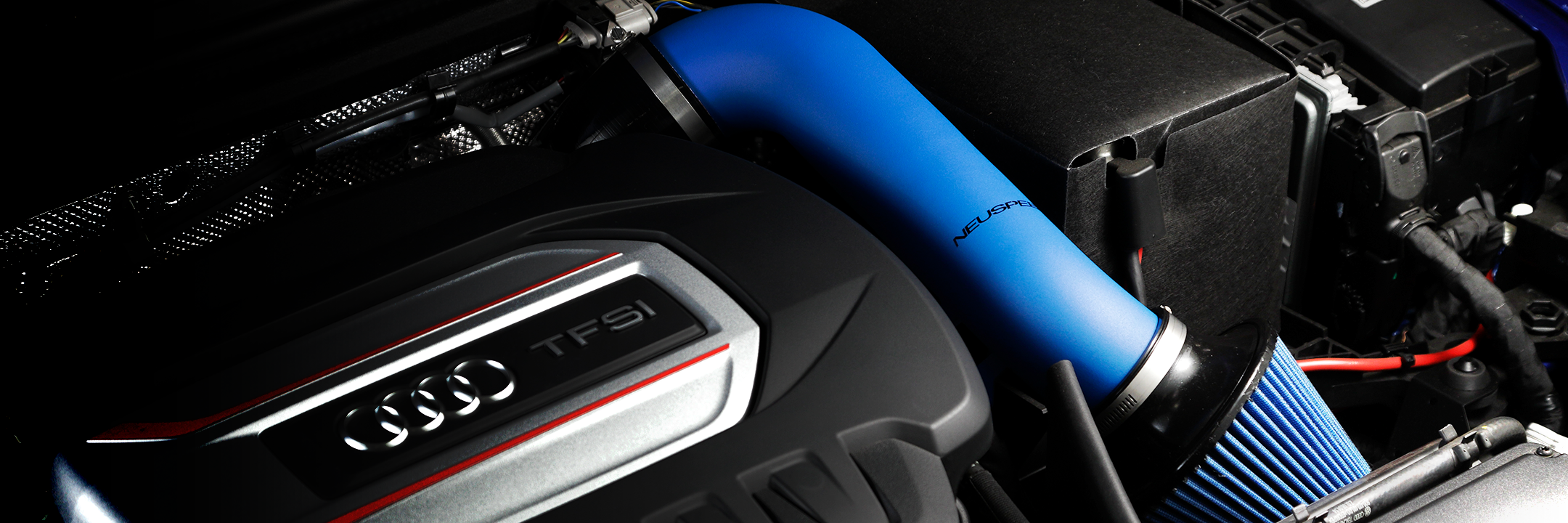
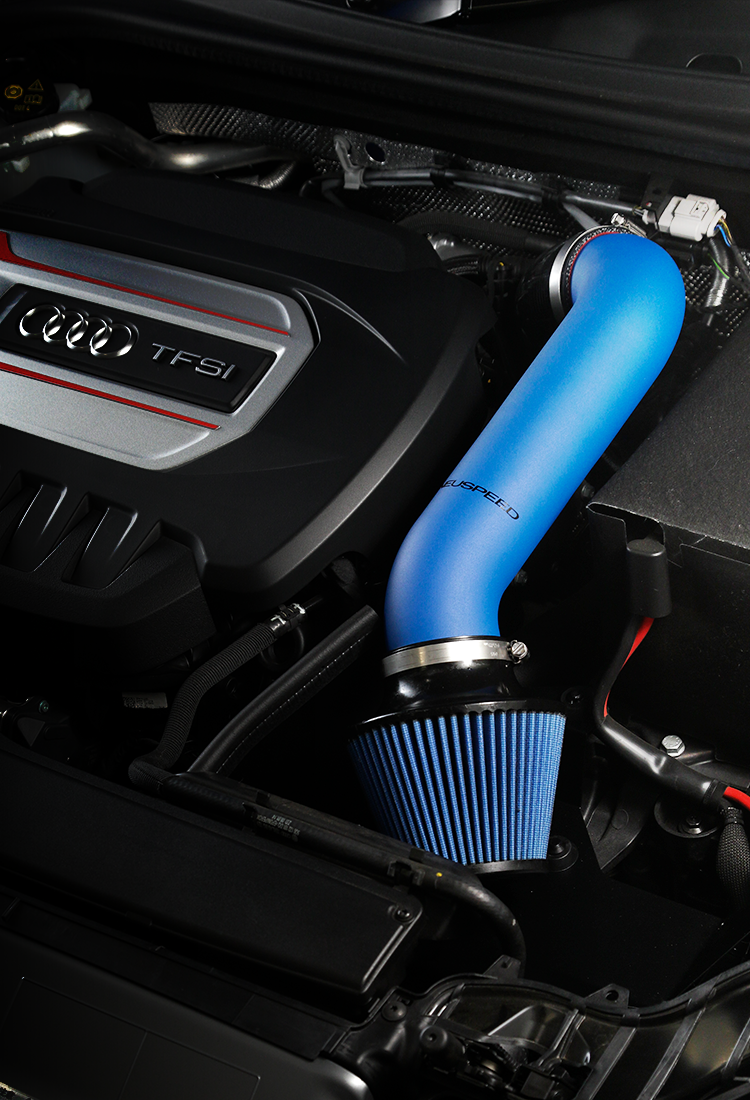
A short ram system usually refers to a open filter (cylindrical or conical shaped) attached directly to the mass air flow meter, or attached via a short velocity tube. In some applications, a heat shield surrounds the filter to reduce the effects of radiant heat coming from the engine. A cold air intake usually refers to either a heat shield that seals to the hood and surrounds the sides and bottom of the filter, or a long extension tube that relocates the filter in the front fenderwell.
The Science Behind an Air IntakeYou've probably heard this before on the internet, "...colder air is denser air, and that means more horsepower." In fact, you've probably heard this enough times that you're convinced it's true, right? Well this might throw you for a loop then: It's entirely possible to gain horsepower with just an open element intake. Drawing in air that is warmer than the outside air does not automatically equate to a horsepower loss when the stock airbox has been removed. Now here is the science behind that statement.
When looking at the properties of gases (and air is a gas) the actual scientific equation for density is:
Density = mass / volume
A quick review of our science book tells us to increase air density you could increase the mass, or reduce the volume. To increase mass, you could increase pressure or reduce temperature. To reduce volume you could increase pressure or reduce temperature. So air pressure and temperature are the two common variables that we have to work with. Everyone likes to talk about temperature, but very few people ever address pressure. Pressure and temperature are equally important.
Pressure, Temperature, and SAE J1349The Society of Automotive Engineers (SAE) has established a test standard that helps standardized engine horsepower testing and results so that the variable effects of barometric pressure, altitude, and intake air temperatures do not bias the test results. The SAE J1349 test procedure includes an engine horsepower correction factor so that, for example, dyno readings taken at 3500 feet on a 40 degree day can be compared with dyno readings taken at sea level on a 77 degree day.
This correction factor is used for Normally Aspirated Engines, not forced induction engines. Once the correction factor is determined, it can be applied to the actual dyno readings so they can be adjusted back to simulate a test conducted at sea level, on a 77 degree day, with 1% humidity.
The SAE correction factor can be approximated using this equation:
CF = 1.18 * (29.235 / Bdo) * ((square root (To + 460) / 537) - 0.153)
where CF = the correction factor, Bdo = the dry ambient barometric pressure in inches of mercury (in/Hg), and To = the intake air temperature in degrees Fahrenheit.
Test 1: The Baseline TestLet's test this equation with a hypothetical engine that dynos at 100HP. We test this engine on a 77 degree day, at sea level. So, we set Bdo = to 29.235 in/Hg and To = to 77F. When we solve the equation for CF, the correction factor equals 1. That means according to SAE, our dyno reading does not require a correction factor for temperature or barometric pressure. It is a true 100HP engine.
Test 2: Temperature = 87 degrees F, Pressure = 29.235 in/Hg What happens when the temperature climbs by 10 degrees, but pressure stays constant? Plugging in 87 for To and 29.235 for Bdo, we can calculate the value of CF. CF = 1.0104. Working our correction factor equation backwards, we take:100hp / 1.0104 = 98.97hp. So, according to the SAE correction factor, a 10 degree increase in temp should result in a loss of 1.03% of rated horsepower, or 1hp on our engine.
Test 3: Temperature = 77 degrees F, Pressure = 28.235 in/HgWhat happens when the pressure drops by 1.0 in/Hg, but temperature stays constant? Plugging in 77 for To and 28.235 for Bdo, we calculate CF and find it equals 1.042. 100hp / 1.042 = 95.96hp. So, according to the SAE correction factor, a 1 in/Hg drop in air pressure should result in a loss of 4.04% of rated horsepower, or 4hp on our engine.
Wow! A drop of 1.0 in/Hg in air pressure is roughly equivalent to climbing approximately 1,000 feet in altitude. That's not very high. The Sear's Tower in Chicago is 1353 feet tall. So, if we put our car in the Sear's Tower freight elevator and take it to the roof, now we have an SAE correction factor of approximately 1.060. We lost almost 6hp just going from the ground floor to the roof level !!
What Does It All Mean?When designing a P-Flo intake, it means we are concerned about how much pressure loss is caused by the stock airbox. For example, barometric pressure at sea level may be 29.235 in/Hg, but air pressure drops as air enters the factory airbox and passes through the filter. So the pressure below the air filter element (on engine side of the intake system) is going to be less than 29.235. How do we know this? There is another SAE test, J726, that is used to calculate the efficiency of air filters. One of the variables measured in this test is the air pressure drop caused by the factory airbox and filter element. We call this pressure drop "Delta P" or differential pressure.
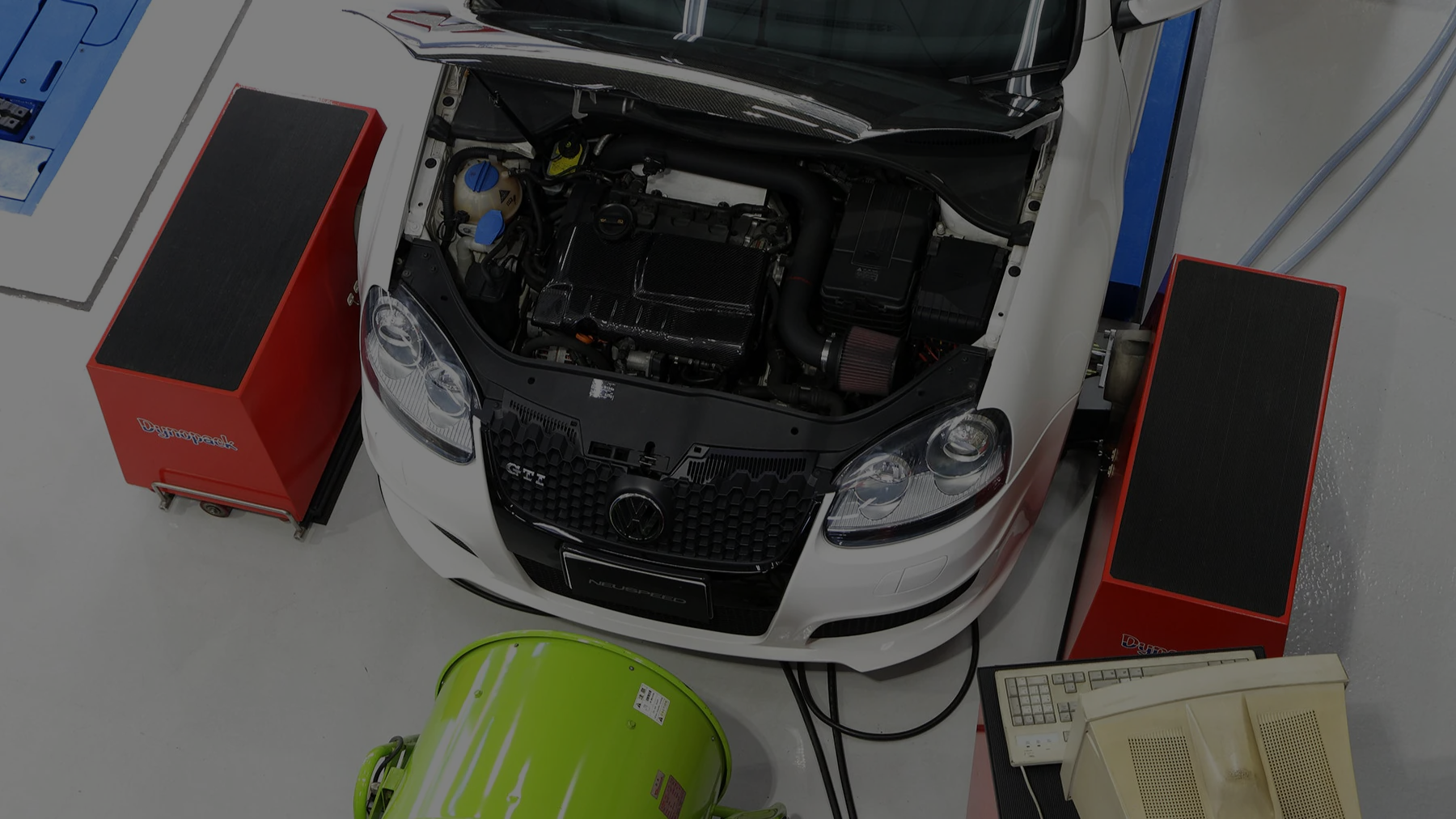
Would you be surprised to find that during the SAE J726 test, the stock airbox can cause a Delta P of anywhere from 15-20psi, depending on the CFM moving through the intake tract? And that just changing the filter element material can result in a 1-5 psi difference? Want to test this in real life? Take a normally aspirated car like the Golf VR6 or the Acura RSX and run two back-to-back dyno tests: One test with the airbox on, one with the airbox totally removed. Did you find a horsepower gain at the higher RPMs without the airbox? You gained HP, and yet the intake air temperature stayed the same or maybe even went higher. So part of the Delta P is caused by restrictions in your factory airbox.
However, during the SAE J726 tests we conducted, we found the Delta P to be lowest when an oiled cotton gauze filter material (K&N style) is used. Synthetic foam filters have the highest Delta P due to the lubricating polymer they are typically coated with. So the other component to lowering Delta P is choosing the air filter element that flows without much restriction, yet still traps dirt.
So, in summary it is entirely possible to gain horsepower just by moving to a short ram intake. Reducing the Delta P will be an improvement on its own. Of course, if you can reduce intake air temperatures AND reduce Delta P, then you have the best of both worlds. But given a choice between the two, Delta P is more important for most vehicles. NEUSPEED makes short ram systems (with and without heat shields) and "CAI" cold air intakes. So the type of filter kit offered for your car is based on what worked the best during our design and testing.
Be advised that CAI systems that place the air filter down into the front fenderwell should not be used in wet, rainy conditions, especially in areas that experience excessive flooding or patches of standing water. If you operate your car frequently in these conditions, we recommend that you use our short ram systems instead to avoid ingesting water into your engine. Water ingestion is a very serious problem and can lead to extensive engine damage.
Try It YourselfHere's an online calculator where you can input different pressure, temperature, and altitude values to see how they affect your engine:
http://www.csgnetwork.com/relhumhpcalc.html
Car manufacturers rate engine horsepower by measuring it at the flywheel. Due to their enormous resources, all car manufacturers have engine dynos. Literally, the engine is completely removed from the car and placed in a test cell. An adapter is fitted over the flywheel, replacing the traditional bell housing. The engine is run at speed in the test cell, and it applies a torque force on a load cell. That torque force is extropolated back to a horsepower figure.
Many aftermarket tuners, including NEUSPEED, use a chassis dyno. A chassis dyno measures the torque generated at the drive wheels, and then extrapolates a road horsepower figure. Road horsepower is always less than engine horsepower due to frictional losses caused by the car's transmission, drivetrain, tire slip on the dyno rollers, and resistance in the dyno itself.
Getting from a chassis dyno HP reading to an estimated flywheel HP reading is simply a function of either (a.) testing an engine on an engine dyno, then the same engine in a car on a chassis dyno and comparing the results; or (b.) testing a very large sample of same type of vehicle and determining what is the difference between the rated engine HP from the manufacturer, and the measured road HP number. There is no such thing as a universal 15% or 20% drivetrain loss! Look this up on the web if you do not believe us. There is no math or engineering currently available to say that all cars on all dynos always have a 15% or 20% frictional loss from the drivetrain.
Each dyno operator is responsible for determining his own estimated conversion from road HP to engine HP using one of the two methods above. Every dyno is different, so if you are starting a test program with your car, always use the same dyno!
There is, however, an accepted SAE correction factor to eliminate the variables of altitude, barometric pressure, and intake air temperature. This is known as SAE J1349.
The Borg Warner (formerly KKK) K03 is used in both the Audi A4/Passat, and the Golf/Jetta/Beetle/TT models. Let's look at the features that are shared in common, and then break out the differences by model.
SimilaritiesThe K03 and K04 share the same bolt pattern for the manifold side and the downpipe/catalytic converter side. They also share the same fitting size and orientation for the coolant and oil lines. Both have an integrated wastegate that connects to the factory VW wastegate control module. So, the K04 is truly a "bolt on" replacement for the K03. Both units spool up very quickly and offer excellent low-mid RPM response and horsepower. The K04 is an excellent "Stage 1" or "Stage 2" upgrade, good for up to 225HP on the A4/Passat, and up to 240HP on the Golf/Jetta/Beetle/TT.
Differences, A4/PassatCompared to the K03 turbo found in all 1997-later Audi A4 1.8T, and 1998-later VW Passat 1.8T, the K04 has a 5mm larger bore and vanes on both the compressor and turbine sides.
Differences, Golf IV, Jetta IV, Beetle, Audi TTCompared to the K03 found in 1999-2000 Golf, Jetta and Beetle 1.8T, and 1999-2000 Audi TT 180HP 1.8T, the K04 has a 5mm larger bore and vanes on both the compressor and turbine sides.
2001-later cars are fitted with a different K03 turbo compared to earlier models. These K03 units already have a 5mm larger compressor side. So, the K04 only offers an advantage on the turbine side, where it has a 5mm larger bore and vanes.
There are additional components you can add to your supercharged engine to increase power output. Please note that not all components are sold by NEUSPEED.
If your car is older, don't forget to inspect the condition of your spark plug wires. A failing wire may cause misfire issues.
As long as you specifically follow the NEUSPEED installation instructions which accompany the NEUSPEED 2.6" pulley (also available as a PDF download on this website) both NEUSPEED and Magnuson Products (the aftermarket service center for Eaton) will continue to honor the terms of the original supercharger warranty.
Please note that damage any damage inflicted on the supercharger during your removal of the old pulley and the installation of the new one is not covered under warranty.
There are a few things that would cause a MAF to fail, but the most common occurrence is a manufacturing defect in the MAF itself. The MAF sensors found in Audi A4, Passat B5/5.5, Golf IV, Jetta IV and Beetle models have had an unusually high number of failures, regardless of whether the stock air intake or an aftermarket intake was used.
Internal sources within Volkswagen have told us that some of the original equipment MAF units have been plagued with manufacturing defects. Unfortunately, there is no absolute way to be certain if your MAF is defective until it fails!
If your car is still under warranty at the time of failure, make your best effort to return your car to a stock engine configuration prior to taking your car to your dealer. Aftermarket engine parts can make it more difficult for your dealer to diagnose your problem.
Spark plugs are typically available in different heat ranges. The plugs that we sell on the NEUSPEED website are suitable for stock engines and mildly modified engines. However, there are times when you might need plug that performs slightly different from our standard listing.
"Hot" and "Cold" refer to whether the plug is higher or lower on the heat range scale compared to the standard replacement plug recommended for your car. A Hot plug will typically have more ceramic insulation surrounding the electrode. For example, if you are experiencing some plug fouling, you could move one heat range hotter on the scale to solve the problem.
On the other hand, perhaps you have some mild detonation (knocking) due to high boost levels or ignition timing advance. You could move one heat range colder to make sure the heat stored in the electrode isn't self-igniting your air/fuel mixture early in the compression stroke. The Cold plug will typically have less ceramic insulation surrounding the electrode.
The engine code is found on a white sticker placed on the top or the side of the timing belt cover.
Some "racing" cams with high lift & duration may cause your car to idle poorly. Similarly, if you have your cam gear advanced or retarded to its maximum adjustment range, this may affect the idle. Finally, you may have simply left a vacuum fitting disconnected.
But let's assume you have a mild cam grind and/or have your cam gear set at 0 degrees. If your car idles very poorly or will not start at all, and you did not modify or disconnect any other parts of your engine, then it is possible that you did not index the cam or cam gear correctly when performing the installation. This could be as simple as being one tooth off when refitting the timing belt. But as a result, your camshaft is out of phase with your crankshaft, i.e. your valves are not opening and closing at the correct interval relative to top dead center (TDC) of the crank. To correct this problem, you or your mechanic should use a degree wheel to "degree in" the crankshaft. To explain this process better, here is an explanation compiled from information from Web Cam Inc., a manufacturer of degree wheel kits, and Crane Cams:
Degreeing In Your Camshaft means synchronizing the camshaft's position with the crankshaft. A few degrees of misalignment can affect the engine's operation dramatically. If there were no manufacturing tolerances, you would only need to line up the marks on the timing chain sprockets and the cam would be degreed, but with a group of components (the camshaft, crankshaft, timing chain, and sprockets) all with their own standards and tolerances that when installed, can stack up against you. You can never be sure that the cam is in it's correct position. Whenever possible, always degree in your cam.
The basic tools required are a degree wheel, a stable pointer that can be mounted to the engine, a dial indicator with at least a half inch of travel in .001" increments with a stand that mounts it to the engine, and a positive stop device to locate T.D.C.
DISCONNECT THE BATTERY! Do not use the starter to perform any of these steps. To find Top Dead Center use a piston stop to stop the piston in the same position on either side of T.D.C. and take readings from the degree wheel. You will then split the difference in these readings and move the pointer this amount, making it the true T.D.C. point. First mount the degree wheel on the end of the crankshaft, and rotate the engine to approximate,T.D.C. Mount the degree wheel pointer onto the center of the degree wheel and line it up at zero on the degree wheel's scale. Now rotate the engine to move the piston down into the cylinder. Install your positive stop device into the spark plug hole and extend the bolt.
Now hand turn the engine rotating until the piston comes up and stops against the bolt. Look at the degree wheel and write down the number of degrees shown by the pointer. Hand turn the engine in the opposite direction until the piston comes up, and stops on the bolt again. Go back to the degree wheel and write down the degrees it now reads. Add these two readings together and divide the answer by two. Now either move your pointer by this many degrees, or carefully loosen the degree wheel (without disturbing the position of the crankshaft) and move the wheel this required amount. Retighten the bolts, and rotate the engine again making sure that the readings on each side of T.D.C. are equal degrees away from zero. If they are, the zero on the degree wheel will now be the true T.D.C. point of the crankshaft. Remove the positive stop device from the spark plug hole.
After you're done finding TDC proceed with the following:
Remove ALL valve lash.
With your dial indicator on the valve spring retainer or follower, rotate the engine in the direction it would normally turn, and come up to .050 inches of lift. Write down that figure. This is your opening figure. This is when the intake opens BEFORE Top Dead Center. Example would be 10 degrees on the degree wheel BTDC.
Now go over the top on the lobe until your indicator is .050 inches off the Base Circle. Now you should be where the intake closes AFTER Bottom Dead Center. Keep in mind to continue turning the engine in the same direction it runs and DO NOT BACK UP. Example would be 39 degrees on the degree wheel ABDC.
Now you can calculate your duration. In this example the valve opens at 10 degrees, plus it closes 39 degrees, plus 180 degrees. (the crank turns 2 times as fast as the camshaft) Your duration at .050 inches of lift would be 229 degrees. (10 + 39 + 180 = 229) Now you can calculate your lobe center . Divide your total duration by 2 and subtract your intake opening figure, (This would normally be the smaller number of the two) (229 / 2) - 10 = 104.5. This is your lobe center.
If your opening and closing figures do not match the specifications of the camshaft installed in your car, you will need to move the cam in relation to the crankshaft in order to correct your opening and closing figures. If the cam is opening early, the cam is too far advanced, and will need to be moved in the opposite direction of the cam rotation. If the cam is opening late, the cam is too far retarded, and will need to be moved in the direction of cam rotation. If you have a double overhead cam engine, check the exhaust camshaft in the same way.
The factory air pump is an emissions control device. Basically, it sucks clean air from the airbox and pumps it directly into the exhaust stream. By diluting the exhaust with clean air, VW is able to get the car to pass emissions testing. Your car may or may not have a factory air pump, depending on the State it was originally sold in.
To determine if your car has a factory airpump, look at the factory airbox. You will always see a large 2-3" air tube leading from the airbox to the throttle body. However, if you see a second, smaller black tube approximately 1-1.5" in diameter going from the airbox to an electrical pump mounted to the front of the engine, then you have an Air Pump equipped car. On MKIII cars, this tube typically exits the factory airbox facing towards the front headlight. On MKIV cars, this tube exits the side of the airbox, pointing towards the engine. MKV & MKVI SLUEV engines the tube is attached to the front side of the air box lid running down below the headlight.